

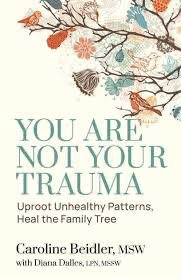
A friend of mine, Caroline Beidler, recently wrote a book called, You Are Not Your Trauma. The book is insightful, honest, raw. But she had me at the title. You are more than the terrible things that have happened to you.
I hold on to that insight now, but it’s something I didn’t used to understand or believe. In fact, from the moment I learned what my adult son Noah had done, I felt sure his violence would define me for the rest of my days.
“Mother of a shooter” became the main way I identified myself—both in my own mind and, at times, to the world. Anything else I could point to—writing, hobbies, family—seemed pointless and insignificant by comparison.
I was my trauma.
Early on, I practically led with it.
One morning when we were still living in New York, I found myself sharing an elevator with a woman who lived with her son a few apartments down from us on the 23rd floor of our Midtown high rise. I knew her name was Hazel, but that’s about all.
The doors had barely closed when she asked how I was doing. And then she asked if I had kids. Which is when I started to sob. “My son committed a shooting!” I blurted. And out poured the awful story as we rode down to the lobby where she patiently heard me out, her tiny dog whining all the while for his walk.
My encounter with Hazel is just one example of what became a pattern. Me blurting out my story to almost anyone who would listen. Of course, the vulnerability hangovers were awful. I had so much shame after an ill-timed spill.
It wasn’t until I moved to Portland and got involved with a grief group for mothers that I began to think more carefully about my relationship with my trauma. My ears perked up when other mothers said things like, “My daughter’s suicide is not my whole story. It’s just a part of my story.”
By then, I was in therapy, working hard to heal, and writing a book about what had happened. At some point, my therapist asked, “What if it’s time to move on from the story about Noah? What would that look like?”
She meant the book. But what I heard was a deeper question: What if it’s time to find a new path forward, one not wholly defined by the tragedy?
At first, I shrank from the idea. It sounded way too much like letting go of my son. Or giving up on hope. I think a part of me felt like if I stopped telling the Noah story, I would lose my power to change how it ended.
There was grief in moving on. But in time, I felt myself being gently ushered into a new era. One that today isn’t all about Noah.
At least not in the old way.
Of course I see the irony. Here I am writing about all of this—for the public, no less. But perhaps I can finally do so, and without shame, precisely because I’m no longer so attached to the story. It’s like I’m outside of it now, talking about the past. My trauma, awful as it was, is something that happened, not something I am.
What a relief!
I notice another irony. By far, the largest part of my healing—what has brought me to a better place— has come from processing my story aloud with my therapists, husband, sister, sponsor, friends, and grief group. It turns out that there are many good reasons to share our stories, and most of them don’t mean we’re over identifying with our trauma. They can just as easily mean we’re doing the hard work of addressing it head on. Trying our best to turn something monstrous and unacceptable into a something we can safely say.
In fact, I read somewhere that you have to tell your story a hundred times to heal.
A hundred times!
Hmm. That number sounds low to me. 😉
I’d love to hear from you. I hope you’ll check out Caroline’s book.


 Heather Kopp